Fillers are widely used in Unsaturated Polyester Resin to control processing behavior, modify product performance, and reduce material costs. Common fillers include calcium carbonate, silica, quartz, alumina trihydrate, talc, clay, and glass microspheres.
However, adding more filler does not always produce a better formulation. An excessive amount can make the resin difficult to mix, reduce flow, trap air, interfere with glass-fiber wet-out, and weaken the finished product.
The correct filler system must balance three important factors: viscosity, mechanical performance, and total production cost. This article explains how fillers affect each of these properties and how manufacturers can determine an appropriate filler loading.
What Are Fillers in Unsaturated Polyester Resin?
Fillers are solid particles dispersed in liquid resin before casting or molding. Depending on the material selected, they may be used to:
Reduce resin consumption
Increase viscosity
Improve stiffness or hardness
Control curing shrinkage
Improve dimensional stability
Modify density
Support flame-retardant performance
Improve surface appearance
Fillers should not be confused with reinforcing fibers. Glass fibers primarily carry structural loads, while mineral fillers usually modify processing, cost, dimensional stability, or selected physical properties.
In SMC and BMC applications, a complete molding compound may contain Unsaturated Polyester Resin, fillers, glass fibers, pigments, initiators, release agents, thickeners, and other additives.
Common Fillers and Their Effects
| Filler | Effect on viscosity | Possible effect on performance | Cost consideration |
| Calcium carbonate | Increases with loading | Can improve hardness and dimensional control | Commonly used to reduce resin consumption |
| Silica or quartz | May increase significantly | Can improve hardness and compressive properties | Depends on particle size and purity |
| Alumina trihydrate | Usually increases viscosity | Can support flame-retardant performance | Functional value may justify higher cost |
| Talc | Modifies flow and rheology | May improve stiffness and stability | Often relatively economical |
| Hollow microspheres | Can increase viscosity | Reduce density but may reduce some strengths | Higher price may be offset by weight savings |
The effects shown in the table are general tendencies. Actual results depend on particle size, shape, surface area, loading level, dispersion, and compatibility with the resin.
How Fillers Affect Viscosity
Viscosity is usually the first property to change after filler is added to Unsaturated Polyester Resin.
Solid particles restrict the movement of the liquid resin. As filler loading increases, particles become closer together and interact more strongly, causing the formulation to become thicker.
The relationship is not always linear. A small increase at a low filler level may produce only a moderate change. The same increase at a high loading level may cause viscosity to rise sharply.
Excessive viscosity can lead to:
Difficult mixing and pumping
Incomplete mold filling
Poor reinforcement wet-out
Air entrapment
Uneven filler distribution
Longer processing time
Surface defects
High viscosity is not always undesirable. It can help prevent fillers from settling and reduce sagging on vertical surfaces. The correct viscosity depends on the production process.
Particle Size
Fine particles have a larger total surface area than coarse particles of the same weight. More resin is required to wet that surface, so fine fillers often increase viscosity more strongly.
A controlled combination of fine and coarse particles may improve packing efficiency. The smaller particles occupy spaces between larger ones, sometimes allowing more filler to be added without making the formulation excessively thick.
Particle Shape
Rounded particles generally flow more easily than angular, flaky, or needle-shaped particles. Irregular particles create more resistance and may increase viscosity considerably.
Particle shape may also affect stiffness, surface quality, and wear resistance. Manufacturers should therefore evaluate both processing and final performance.
Temperature and Mixing
Unsaturated Polyester Resin usually becomes less viscous as temperature increases. The same filled formulation may therefore flow differently in summer and winter.
Mixing conditions also matter. Insufficient mixing can leave agglomerates, while overly aggressive mixing may introduce air and increase material temperature. Mixer speed, blade design, mixing time, and the order of addition should be standardized.
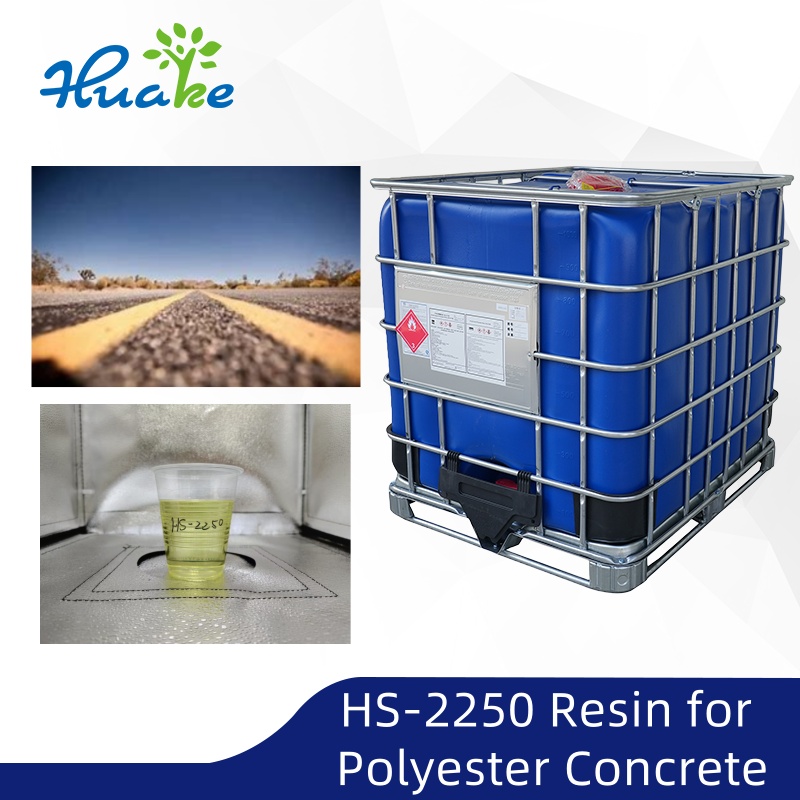
Huake’s official HS-2250 product image shows the resin, packaging, and a polyester concrete application.
How Fillers Affect Strength
The effect of filler on strength is more complicated than its effect on viscosity. A filler may improve one property while reducing another.
Stiffness and Hardness
Rigid mineral particles can restrict deformation of the cured polymer matrix. Properly selected fillers may therefore improve stiffness, surface hardness, compressive behavior, or wear resistance.
However, stiffness and strength are not the same. A formulation can become harder and more rigid while also becoming more brittle.
Tensile and Flexural Properties
The resin must wet and bond to the filler surface. Good dispersion and a suitable resin-filler interface help transfer stress through the material.
Poor compatibility can create weak boundaries where cracks begin. Agglomerated filler particles and trapped air also act as stress concentration points.
At excessive loading, there may not be enough resin to bind the particles and reinforcement effectively. As a result, tensile strength, elongation, impact resistance, or flexural strength may decrease.
Mineral fillers should not be treated as substitutes for glass-fiber reinforcement in structural FRP products.
Impact Resistance
High amounts of rigid filler often reduce elongation and increase brittleness. This can make a component more vulnerable to impact, vibration, or repeated loading.
If the product will experience shock or fatigue, manufacturers should conduct relevant tests on the complete cured formulation rather than relying only on neat-resin data.
Shrinkage and Dimensional Stability
Mineral fillers do not cure and shrink in the same way as the resin matrix. Replacing part of the reactive resin with stable solid material can reduce overall curing shrinkage.
This is useful in polyester concrete, cast products, SMC/BMC components, and tooling applications. Lower shrinkage can improve dimensional accuracy and reduce warpage or visible reinforcement patterns.
Nevertheless, filler is only one part of shrinkage control. Resin chemistry, cure speed, mold temperature, part thickness, and low-profile additives can also influence the result.
How Fillers Affect Cost
Basic mineral fillers, such as calcium carbonate, often cost less per kilogram than Unsaturated Polyester Resin. Replacing part of the resin with filler can therefore reduce direct material cost.
This approach is common in cast products, artificial stone, polyester concrete, and molding compounds.
For example, Huake describes its HS-2250 Unsaturated Polyester Resin as a low-viscosity resin designed for polyester concrete, with filler-wetting characteristics intended to support high filler loading.
However, the cheapest formulation per kilogram may not produce the lowest-cost finished part.
Hidden Costs of High Filler Loading
Excessive filler can increase:
Mixing time
Energy consumption
Equipment wear
Mold-filling time
Air-removal requirements
Surface finishing
Scrap and rework
Hard mineral fillers may increase wear on pumps, mixers, screws, molds, and cutting equipment. Dense fillers can also increase the weight of the finished component and raise transportation or installation costs.
The correct calculation should therefore include the total cost per acceptable product, not only the prices of the resin and filler.
Functional Fillers
Some fillers are selected primarily for performance rather than cost reduction.
Alumina trihydrate may be incorporated into a properly designed flame-retardant system. Hollow microspheres may reduce product density. Specialized fillers may also support improved thermal behavior, surface finish, or electrical properties.
These fillers can cost more than common minerals, but their functional benefits may help the finished product meet important performance requirements.
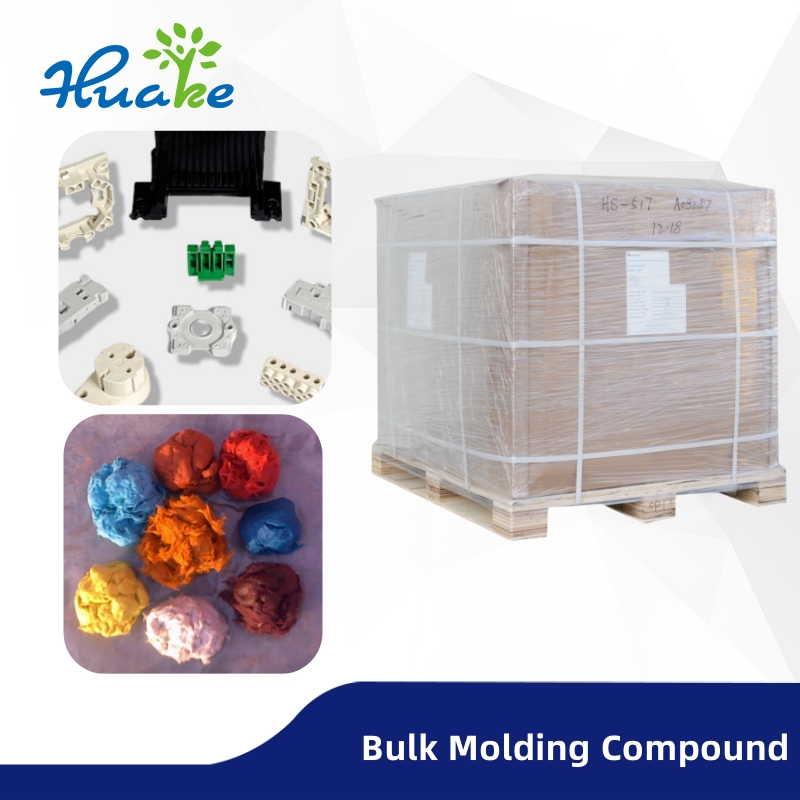
Huake’s official BMC image shows molding compound, industrial packaging, and representative molded components.
Filler Loading Must Match the Process
Different manufacturing processes require different viscosity and flow characteristics.
A polyester concrete or casting formulation may contain a relatively high amount of mineral filler. A hand lay-up resin must remain fluid enough to wet glass-fiber reinforcement properly.
SMC and BMC systems require carefully controlled rheology. During molding, the material must flow under heat and pressure, fill complex mold features, carry reinforcement, and release successfully after curing.
Huake’s Bulk Molding Compound is described as a compound containing resin, mineral fillers, glass fibers, initiators, release agents, thickeners, and processing aids. Its performance therefore depends on the balance of the complete formulation.
How to Optimize a Filled Resin Formulation
1. Define the Required Performance
Determine the target viscosity, strength, stiffness, impact resistance, shrinkage, density, surface quality, and environmental resistance.
2. Select the Appropriate Resin
Choose an Unsaturated Polyester Resin designed for the intended process and filler loading. Low initial viscosity may support higher filler content, but curing and mechanical performance must also be considered.
3. Control Filler Quality
Check particle size, shape, moisture content, purity, color, and surface treatment. Variations between filler batches may change viscosity and molding behavior.
4. Test Several Loading Levels
Prepare controlled batches with different filler contents. Measure viscosity, gel time, cure quality, shrinkage, and the mechanical properties relevant to the product.
5. Conduct Production Trials
Laboratory tests cannot reproduce every factory condition. Trials should use the actual mixer, reinforcement, molds, temperatures, and production cycle.
6. Calculate Total Cost
Include material consumption, labor, energy, equipment wear, cycle time, transportation, rejects, and finishing. Select the formulation that provides the required performance at the lowest reliable total cost.
Common Mistakes to Avoid
Manufacturers should avoid:
Adding filler without checking viscosity
Assuming more filler always means lower cost
Using damp or inconsistent filler
Treating filler as structural reinforcement
Ignoring air introduced during mixing
Changing filler loading without checking gel time
Scaling a laboratory formula directly into production
Comparing test data obtained under different conditions
All materials should be handled according to their safety data sheets. Appropriate ventilation, protective equipment, and dust-control procedures are necessary.
Conclusion
Fillers can significantly affect the viscosity, strength, and cost of Unsaturated Polyester Resin.
Increasing filler content normally raises viscosity and reduces resin consumption. A suitable filler may improve stiffness, hardness, dimensional stability, or functional performance. Excessive or poorly dispersed filler may reduce flow, trap air, weaken the resin-filler interface, and make the final product brittle.
The best formulation is not the one containing the highest filler loading. It is the one that achieves the required properties, processes consistently, and delivers the lowest total cost per acceptable finished product.
Manufacturers should evaluate the resin, filler, reinforcement, curing system, and production conditions as one complete system. Laboratory testing followed by full-scale trials provides the most reliable basis for determining an appropriate filler level.


