Refinishing a boat hull or deck demands heavy labor and significant time. You have to decide whether to re-apply a factory-style finish or switch to a topside marine paint. This choice forces you to balance upfront application effort against long-term maintenance, aesthetic versatility, and structural durability. Evaluating the true lifespan of these finishes requires separating physical durability from aesthetic longevity. Physical durability means structural protection against impacts and water intrusion. Aesthetic longevity involves gloss and color retention under harsh marine environments. You cannot simply ask which product lasts longer without defining what failure looks like for your specific vessel. This guide breaks down the chemical realities, maintenance cycles, and long-term financial impact for both options.
Key Takeaways
Physical vs. Aesthetic Lifespan: Gelcoat offers superior physical thickness and can last 20–40 years as a protective barrier. High-end 2-part marine paints maintain their color and gloss longer without heavy maintenance but typically require repainting every 10–15 years, while 1-part paints generally fail and require recoating every 5 years.
Maintenance Trade-offs: Gelcoat is porous and demands an aggressive annual regimen of compounding and waxing to prevent oxidation; marine paint requires only gentle washing but cannot be restored with abrasive compounds once the clear coat fails.
Repairability: Gelcoat is highly forgiving for spot repairs and color matching over time. Paint—especially 2-part polyurethane—is prone to chipping and notoriously difficult to blend seamlessly after a repair.
Application Constraints: Gelcoat application is labor-intensive, requires specific temperature controls, and has a short shelf life, whereas paint offers more flexibility for DIY applications via roll-and-tip methods and provides a broader spectrum of custom colors.
Understanding the Baseline: Chemical Composition
What is Fiberglass Gelcoat?
Builders apply Fiberglass Gelcoat directly to the mold during the initial manufacturing process. It is a specialized, modified Marine Resin formulated using polyester or vinylester bases. Restorers also spray it heavily during major vessel rehabilitations. Its primary function remains structural. It protects the underlying fiberglass laminate from water intrusion, blistering, and UV degradation. The main advantage here is physical thickness. Applicators spray this material at 15 to 25 mils thick. This creates a highly robust, sacrificial layer. You can sand, compound, and polish it repeatedly over decades without burning through to the structural fiberglass beneath. It acts as a heavy-duty shield for the boat. When you drag a heavy cooler across the deck or bump a piling, this thick resin layer absorbs the abuse.
How Marine Paint Differs
Marine paint operates on entirely different chemical principles. The market categorizes these paints primarily into 1-part and 2-part polyurethanes. A 1-part polyurethane offers easier application and lower upfront costs, but it sacrifices durability. A 2-part polyurethane, such as Awlgrip or Alexseal, relies on a chemical catalyst. These components cross-link during the curing process, creating an exceptionally hard, durable shell. Unlike resin-based finishes, paint is a thin-film coating. Applicators lay it down at just 2 to 3 mils per coat. Because it is so thin, it offers almost no structural protection. It relies entirely on the underlying substrate for impact resistance. However, paint provides unmatched aesthetic versatility. It delivers a significantly broader spectrum of colors. You can achieve custom color matches, deep dark hues, and metallic finishes that pigmented resins simply cannot replicate.
| Feature | Fiberglass Gelcoat | 1-Part Polyurethane Paint | 2-Part Polyurethane Paint |
| Applied Thickness | 15 - 25 mils | 2 - 3 mils | 2 - 3 mils |
| Structural Protection | High (Sacrificial layer) | Low (Cosmetic only) | Low (Cosmetic only) |
| Color Versatility | Limited (Fades quickly in dark colors) | Moderate | Extensive (Custom matches, metallics) |
| Curing Mechanism | Catalyzed (MEKP) | Air dried / Evaporation | Chemically cross-linked |
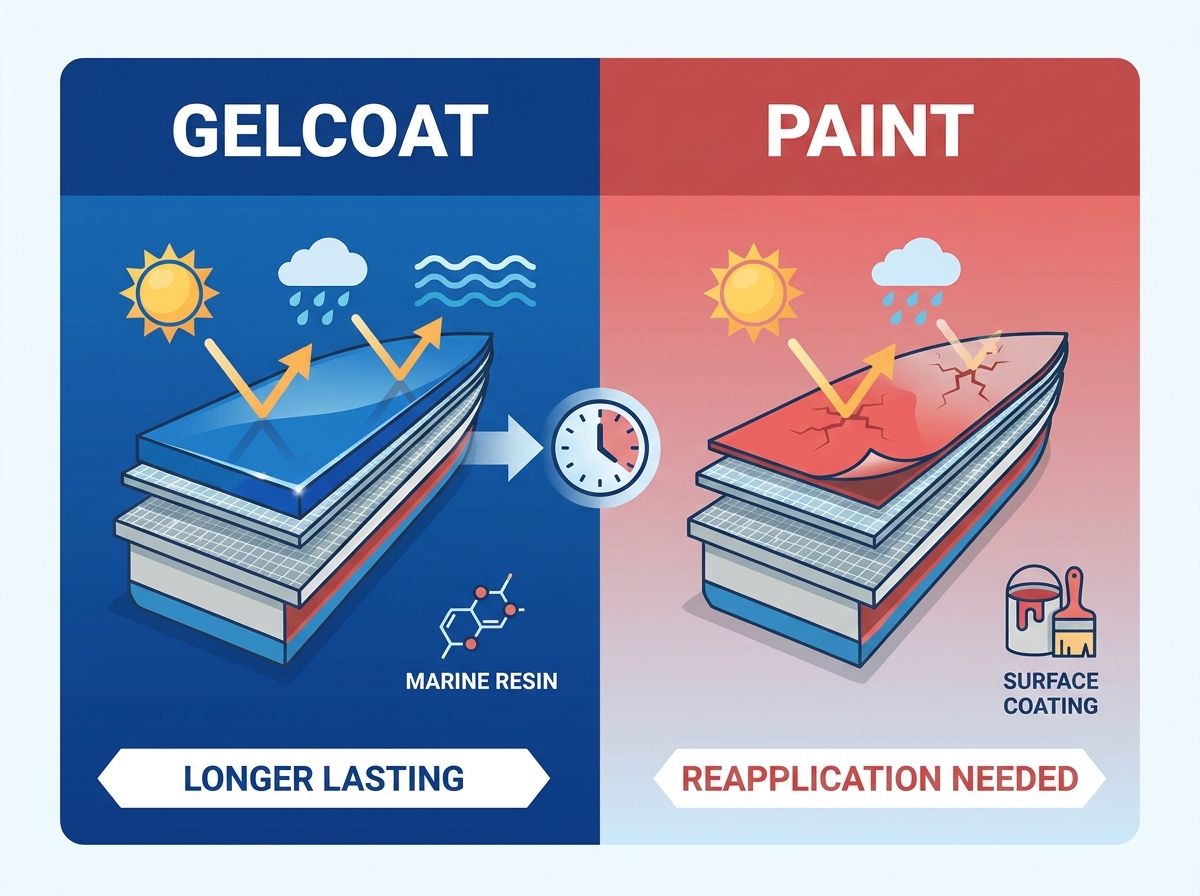
The Longevity Debate: Which Actually Lasts Longer?
Physical Durability and Abrasion Resistance
When assessing impact resistance, the thicker factory finish wins easily. Boats frequently rub against docks, pilings, and floating debris. A thick resin layer absorbs these blunt impacts. It might scuff or scratch, but it rarely exposes the fiberglass beneath. You can usually wet-sand and buff out these minor abrasions using standard yard tools. Paint behaves differently under blunt force. Because it is a thin, rigid film, it tends to chip or crack upon impact. A hard strike against a piling will often scratch the paint straight down to the epoxy primer. Once the primer is exposed, the aesthetic continuity breaks. You cannot simply buff out a deep paint chip. It requires a dedicated touch-up that often remains visible to the naked eye.
UV Degradation and Aesthetic Lifespan
Sunlight destroys marine finishes. A high-quality Weather Resistant Gelcoat performs well structurally under constant UV exposure, but it struggles aesthetically over time. The material is naturally porous. UV rays and oxygen break down the surface, causing chalking and heavy oxidation. Without constant maintenance, dark colors fade rapidly. White hulls turn dull and yellow. High-end 2-part marine paints handle UV exposure much better. They contain advanced UV inhibitors and form a non-porous, cross-linked surface. This tight chemical structure seals out oxygen and reflects sunlight. As a result, a painted hull retains its wet look and color depth two to three times longer than an unmaintained resin finish. Dark blue or black painted hulls can look flawless for a decade without ever seeing a buffer.
The Verdict on Lifespan
Lifespan depends entirely on your definition of failure. For pure structural longevity, the factory-style resin wins. It can protect a hull for up to 40 years before requiring a complete re-spray. For maintenance-free aesthetic longevity, 2-part polyurethane paint is the clear winner. It maintains brilliant gloss for 10 to 15 years with minimal effort. Meanwhile, 1-part paints trail significantly. They typically lose their gloss and require complete reapplication every 5 years.
Maintenance Realities and Long-Term Expenses
The Gelcoat Maintenance Cycle
Maintaining a porous resin finish demands aggressive annual labor. You cannot simply wash it and walk away. The required maintenance cycle involves heavy oxidation removal using a rotary buffer and cutting compounds. Skipping this maintenance accelerates UV degradation, leading to a chalky hull that requires even more aggressive wet-sanding to restore.
Follow this standard annual maintenance sequence to keep the finish intact:
Wash the hull thoroughly with a heavy-duty marine soap to strip old wax and surface contaminants.
Remove heavy oxidation using a rotary buffer equipped with a twisted wool pad and a heavy-cut rubbing compound.
Switch to a foam polishing pad and a medium polish to remove swirl marks and restore optical clarity.
Apply a high-quality marine paste wax or synthetic polymer sealant to fill the pores and block UV rays.
Reapply the wax layer mid-season for boats stored outdoors in high-UV environments.
This cycle is physically exhausting. If you hire professionals, the annual detailing bills add up quickly. Over a 10-year period, the cumulative cost of detailing products, buffing pads, and labor often exceeds the price of a premium paint job.
The Marine Paint Maintenance Cycle
Two-part marine paints flip the maintenance script entirely. They come with a strict wash-only requirement. You maintain the finish using specialized, pH-neutral boat soaps and soft brushes. You must actively avoid carnauba waxes, abrasive compounds, and stiff deck brushes. The cross-linked surface does not need wax to maintain its shine. However, this low-maintenance profile carries a severe risk. If you attempt to polish a 2-part polyurethane with abrasive compounds, you will permanently destroy the finish. The clear coat layer is microscopically thin. Once you burn through it with a buffer, the paint becomes dull and unrepairable. You must follow the manufacturer's maintenance guidelines flawlessly.
Cost Analysis: 5-Year vs. 20-Year Horizon
A professional 2-part paint application requires high upfront capital. The surface preparation, priming, and controlled spray environment drive up labor costs significantly. In a 5-year horizon, painting appears much more expensive than simply buffing an existing factory finish. Expand that horizon to 20 years, and the math changes. A painted boat requires zero annual compounding labor. A resin-finished boat requires 20 consecutive years of heavy detailing. Despite the higher annual labor, maintaining a thick factory finish often proves more cost-effective over two decades because you avoid the massive capital outlay of stripping and repainting the vessel multiple times.
Application Complexity and Refinishing
Surface Preparation Requirements
Surface preparation dictates the success of any marine coating. Prepping for a new resin application requires aggressive sanding. You must remove all contaminants and create a heavy mechanical scratch profile. We typically use 80-grit paper on a dual-action sander for the new material to grip. Managing the chemical bond is critical. The substrate must be pristine, completely dry, and free of any previous paint. Prepping for paint is equally demanding but focuses on absolute smoothness. Paint hides nothing. Every pinhole, scratch, and uneven surface will show through the final high-gloss coat. The prep involves extensive fairing, multiple coats of high-build epoxy primer, and meticulous block sanding with 320-grit or 400-grit paper. Furthermore, spraying 2-part paint requires a strictly dust-free environment, often necessitating a professional spray booth.
Environmental Constraints and Material Limitations
Marine resins are highly sensitive to environmental conditions during application. You must maintain strict temperature and humidity controls. If it is too cold, the catalyst will not activate properly. If it is too hot, the material will harden in the spray gun before you can apply it to the hull. Material stability is another constraint. Liquid resin has a notoriously short shelf life. It typically lasts only 3 to 4 months when stored at 70°F. Once it passes its expiration date, it may never cure properly. In contrast, unmixed paint components offer much longer shelf stability, giving DIYers and yards more flexibility in scheduling their projects.
Special Considerations for Decks and Non-Skid Surfaces
Decks endure constant foot traffic, dropped tools, and dragging equipment. A factory-applied non-skid resin provides a thicker, harder-wearing profile. It stands up to heavy abuse and aggressive scrubbing much better than a painted deck. You can aggressively clean a resin deck with stiff brushes and bleach without fear of peeling the finish. Deck paint offers a different set of trade-offs. Many boat owners use 1-part deck paints mixed with non-skid additives like pumice or polymer beads. These are incredibly easy for DIY roll-on applications. However, they lack physical durability. The non-skid peaks wear down quickly under foot traffic. Expect to recoat a painted non-skid deck every 3 to 5 years to maintain traction and appearance.
DIY vs. Professional Execution
For the ambitious DIYer, marine paint offers a viable path. You can apply many high-quality 1-part and 2-part paints using the roll-and-tip method. One person rolls the paint on with a high-density foam roller, while a second person lightly drags a badger-hair brush over the wet edge to pop bubbles and level the finish. This yields excellent results without a spray booth. Re-applying a full resin finish is rarely a DIY project. It requires heavy-duty spray equipment with large fluid nozzles to handle the thick viscosity. More importantly, it requires massive post-application labor. Sprayed resin cures with a textured, orange-peel surface. You must wet-sand the entire boat starting at 400-grit and work up to 2000-grit before compounding and polishing to achieve a mirror finish.
Repairability: Handling Scratches, Dings, and Scuffs
Spot-Correcting Gelcoat
The greatest advantage of a thick resin finish is its repairability. When you gouge the hull against a dock, the repair process is straightforward. You grind out the damage with a rotary tool, mix a small batch of catalyzed paste, fill the gouge, and let it cure. You then sand it flush with 600-grit paper and buff it out. Color matching is highly forgiving over time. Even if the hull has faded from UV exposure, you can blend the new repair into the surrounding oxidized area. A skilled technician can make a spot repair virtually disappear. This makes Gelcoat the ideal surface for boats that see heavy use, frequent trailering, or regular contact with hard surfaces.
The Challenge of Blending Paint
Paint fails the repairability test. Two-part polyurethanes are notoriously difficult to spot-repair. If you scratch the paint, you cannot simply fill it and buff it out. Applying new paint over a small spot creates a visible halo effect where the new clear coat overlaps the old clear coat. Because you cannot seamlessly blend the edges, professional yards rarely attempt spot repairs on high-end painted hulls. Instead, they must repaint entire panels. If you scratch the port side of the hull, the yard will likely need to prep and spray the entire port side from the bow breakline to the stern breakline to ensure a perfect color match. This turns a minor docking mistake into a major financial burden.
| Repair Aspect | Resin Finish | 2-Part Marine Paint |
| Spot Repair Feasibility | Excellent (Can be blended seamlessly) | Poor (Creates a visible halo effect) |
| Color Matching | Forgiving (Can match faded surfaces) | Difficult (Requires exact batch matching) |
| Required Scope of Work | Localized to the damaged area only | Often requires repainting the entire panel |
| Post-Repair Finishing | Wet-sanding and heavy compounding | Light polishing only (if permitted by manufacturer) |
Implementation Risks and Mitigation Strategies
Common Gelcoat Application Failures
Applying marine resin carries specific chemical risks. Under-curing is a primary failure point. If you do not add enough MEKP catalyst, the surface will remain tacky and eventually exhibit alligatoring, which looks like a wrinkled, cracked texture. Improper mixing also introduces air bubbles, leading to subsurface porosity that eventually blisters. Styrene evaporation issues also plague poor applications. If the material is sprayed too thin, the styrene evaporates before the cross-linking completes, leaving a weak, chalky finish. Mitigation requires strict adherence to MEKP catalyst ratios based on ambient temperature. You must use a mil-gauge during application to ensure adequate thickness and monitor the surface temperature closely.
Paint Adhesion and Peeling Risks
Paint failures almost always stem from poor adhesion. Blistering and peeling occur when moisture gets trapped under the coating or when the paint is incompatible with the previous finish. Applying a strong 2-part solvent-based paint over an old 1-part paint will cause the old layer to lift and wrinkle instantly. Mitigation starts with a solvent test to identify existing finishes. You must completely strip incompatible coatings. Using high-build epoxy primers creates a reliable tie-coat between the fiberglass and the topcoat. Furthermore, you must ensure absolute moisture control. Painting over a hull with high moisture meter readings guarantees future blistering.
Conclusion
Choosing between these two finishes comes down to how you use your boat and your tolerance for maintenance. The factory-style resin is the superior choice for physical durability, impact resistance, and repairability. It is the workhorse finish, ideal for heavily used vessels, fishing boats, and high-traffic decks. Marine paint, specifically 2-part polyurethane, dominates in long-term color retention, custom color spectrums, and low day-to-day maintenance. It is the premium choice for yachts and lightly used cruisers that prioritize a flawless aesthetic.
Use this shortlisting logic to make your final decision:
Choose to restore or re-apply a resin finish if the boat frequently contacts docks or trailers, you prefer doing your own spot repairs, or you want a robust finish that can last 30 to 40 years with proper seasonal care.
Choose marine paint if the existing surface is too thin to restore, you want a custom dark or metallic color, or you want to eliminate the grueling annual compounding process.
Take the following next steps to begin your refinishing project:
Conduct an acetone solvent test on an inconspicuous area to identify your current hull finish.
Measure the remaining thickness of your existing surface near high-wear zones like the bow and cleats.
Consult a local marine refinishing yard to assess the structural integrity of the underlying fiberglass.
Select your coating system based on your willingness to perform annual compounding and waxing.
FAQ
Q: How do I know if my boat currently has gelcoat or paint?
A: Perform the acetone test. Soak a clean white rag in acetone and rub it aggressively on an inconspicuous area of the hull. Acetone will dissolve or transfer 1-part paint onto the rag. It will slightly dull a 2-part polyurethane paint. However, acetone will not affect or transfer color from a fully cured factory resin finish. Visual cues also help. Paint tends to chip or peel, while resin tends to chalk and oxidize.
Q: Can you apply marine paint directly over old gelcoat?
A: Yes, provided the surface is meticulously prepared. You must thoroughly de-wax the entire hull using specialized solvents. Next, you must sand the surface aggressively to create mechanical adhesion. Finally, you must seal the porous resin with a high-quality, two-part epoxy primer before applying the final marine paint topcoat.
Q: Can you apply new gelcoat over marine paint?
A: No. Heavy marine resins will not chemically or mechanically bond to any type of paint. The solvents in the resin will attack the paint, causing immediate lifting and failure. If you want to return to a factory-style finish, you must completely sand or grind away all existing paint down to the original fiberglass or bare resin substrate.
Q: Why does gelcoat fade faster than paint?
A: The material is naturally porous. When exposed to UV rays and atmospheric oxygen, the surface oxidizes, creating a dull, chalky layer that masks the pigment. High-end marine paints utilize tightly cross-linked polymers. This creates a non-porous shell that seals the surface, reflects UV rays more effectively, and prevents the oxygen intrusion that causes rapid fading.
Q: Is it cheaper to paint or gelcoat a boat?
A: Painting is generally less labor-intensive for a DIYer using the roll-and-tip method. However, paying a professional yard for a premium 2-part paint job requires higher upfront capital than having them wet-sand and restore an existing factory finish. Re-spraying an entire hull with new resin from scratch is the most labor-intensive and costly option of all.
Q: How long does a marine paint job last compared to gelcoat?
A: With proper care and gentle washing, a high-quality 2-part polyurethane paint job can maintain its gloss for 10 to 15 years. Lower-cost 1-part paints typically degrade and require recoating every 5 years. In contrast, a structurally sound, well-maintained factory resin finish can protect a hull for up to 40 years, though it requires constant polishing.


